Friday, October 31, 2008

Modern Democratic Ideology in Economic Perspective

American Liberalism


Before understanding the economic agenda of the Democratic Party, it is important to first understand the political ideology of the Democratic Party. Traditionally, Democrats believe in social liberalism.


Liberalism is a political ideology that seeks to maximize individual liberty. Liberalism in the United States is known as social liberalism which should not to be confused with classic liberalism, as referred to in the rest of the world.

Social liberals believe in moral values such as empathy, compassion, trust, and cooperation. Generally, they believe that the State must provide the necessary socioeconomic support such as education and welfare for the poor and the helpless in order to achieve positive freedom and social justice. Such beliefs lead American liberals to support progressive income taxes, regulation of society, and more state enterprises. They support:


  • Government spending on education, health care, child care, and often many state enterprises.
  • National health insurance or universal health care in a variety of forms to address the rising costs of modern health insurance
  • Regulatory bodies over private enterprise in the interests of workers, consumers and fair competition.
  • Spending on social security.
  • A moderate or heavy level of taxation.
  • Decentralized decision-making.
  • Internationalism.

Centrism, The Third Way


However, as the Democratic base traditionally dominated by labor unions and working class became more diverse to include the intelligentsia and college-educated professionals, the Democratic base today includes a significant number of conservatives in addition to liberals. In recent decades, the Democratic Party has adopted a centrist economic and more socially progressive agenda.

Today, Democrats advocate more social freedoms, affirmative action, balanced budget, and mixed economy. The party believes that government should play a role in alleviating poverty and social injustice, even if such requires a larger role for government and progressive taxation.


Related Links:


Tuesday, October 28, 2008

American Economy Turning Into Socialism?

If you have paid attention to the news or radio lately, you most likely heard the term socialism a lot over the last couple of weeks. You may be wondering what socialism has got to do with America. My understanding is that people are concerned with the recent intervention by the US government seen by many as socialist measures.


The US government is planning to buy up large stakes in major banks across America. In the traditional American economic system, that was unthinkable. Yet, the economy has gotten so bad that the government has no choice but to take drastic measures.


In socialism, the ruling regime takes ownerships of core capital infrastructure of the economy. The banking system is vital to the economy and can be regarded as economic infrastructure. If the US government takes over major financial institutions, would it be the end of American capitalism? Apparently, the US economy is already disintegrating.


In fact, many economy professors would happily tell you that the American economic system is not perfect capitalism, but indeed a hybrid system of capitalism and socialism. In the current crisis, it may seem that the US economy is shifting toward socialism.


Related Posts:


Friday, October 24, 2008

Investment Tips: Weathering the Financial Crisis

Washington Post has a good discussion section where you can find enlightening discussions on various topics and read helpful advices from experts. I found an interesting business discussion in which Tim Hanson of The Motley Fool answered investment questions dealing with the financial crisis. Some of the key points are as follows:


  1. The stock market is a crazy and irrational place that fluctuates violently according to news and rumors. However, in the long term, stocks are much more predictable. If you focus on diversification, smart allocation, and companies with strong brands, balance sheets, and good management teams, you can be a successful long-term investor. Good companies will attain to their intrinsic/fundamental values over the long term.


  2. In times of financial instability, do some asset reallocation. Move your funds from small cap funds to large cap funds or bonds.


  3. If you are relatively young, it's okay to invest more in stocks. But if you are nearing retirement, invest in high cap stocks or bonds.


    If you're more than 10 years from retirement, you want to be 80% to 90% in stocks. If you're 3 to 10 years from retirement, you want to be 60% to 70% in stocks. And if you're nearing or in retirement, you want to be about 50% in stocks and 50% in principal-protecting bonds and treasuries.


  4. When the market crash causes every stock value to plummet, it creates opportunities for long-term investors to buy normally high stocks at a bargain and diversify their portfolio. Also diversify your investment outside the US. Foreign stocks in China, Brazil, India, Europe and the like provide good value/growth opportunities.


  5. Use dollar-cost averaging technique for investments such as Roth IRA. You can get more bang for your buck as the market drops. Make sure you invest in chunks that are big enough to keep transaction costs to less than 1% or 2% of your investment.


  6. Generally speaking, if you own an index fund, that's going to be so broadly diversified that owners have no reason to panic. They're generally low-cost, broadly diversified, and offer returns that most well-paid active mutual fund managers can't beat.


Check out the full read: The Financial Crisis And You: Impact on Your Investments

Thursday, October 23, 2008

Backing Up Data

Last Sunday, my 320GB hard drive in a USB enclosure crashed. The hard drive makes clicking noise and is not recognized any more. I think the hard disk crashed due to overheat. I am very disappointed. To my relief, there was no critical data lost.


This incident made me realize the importance of backing up data. Here I give my tips on backing up data.


Backup Medium


Since my hard drive crashed, I don't recommend hard drives as backup media. Hard drives are vulnerable to heat, magnetic force, and electric surge. I recommend Compact Discs, DVD±R, DVD-RAM or flash drives.


Backup Software


If you have a powerful CPU, spare time and huge storage, it may make sense to back up the whole thing including the operating system, applications and all the data. This typically involves backing up the whole hard drive or a hark disk partition.


There are many commercial software that are designed for this kind of task. Popular ones are Norton Ghost and Acronis True Image. There's free one, too. I recommend Clonezilla for free disk imaging solution.


Online Storage


The simplest way to back up your data online is saving it in your email server. Some webmail services such as Yahoo! mail provide unlimited email storage. With Zimbra Desktop, you can save your documents or pictures directly in your mail server.


Otherwise, there are many online services that provide backup solutions. I recommend the online service Carbonite.

Monday, October 20, 2008

Outlook on eBook Business

I've been aware of ebooks since long ago. In fact, I was scouring the
Internet for ebooks of all sorts, including literature and technical
books years ago. I haven't been collecting ebooks for quite a while,
but when I checked recently for an economy textbook, I found tons of
ebooks, including various collegiate books. That's intellectual bonanza.


Anyway,
what I am trying to say is, is it reasonably feasible to make profits
from ebooks? Just take a look at all the publications and audio books
circulating in the IRC networks and sharing networks.


When
a publisher sends manuscripts of books in PDF form to a printing house,
some of these manuscripts get leaked to the Internet. Even if the
manuscripts are in encrypted PDF form, it's possible to break the encryption. Years back, there was one hacker who succeeded in breaking the encryption but got arrested by FBI (Poor guy, what about freedom of speech).


However,
if someone becomes successful in selling ebooks for reading on cell
phones or iPods, ebooks can possibly become a profitable trend.


Recent rampant success of Apple iPhone and its App Store
has opened opportunities for many entrepreneurs. I don't own an iPhone,
hence I don't know what's available in the iPhone App Store. But
piggybacking on iPhone madness, developing an ebook reader for iPhone
and making deals with publishers or even wanna-be writers might be a
good business idea.


Anyway, if you are into serious classic literature without much concern for modern recyclable literary garbages, I recommend Project Gutenberg. Gutenberg is a wonderful philanthropic repository of copyright-free literature.

Sunday, October 19, 2008

Microsoft Weakening? Upcoming OS Battle

Now that Bill Gates has shifted his endeavors from monopolist Microsoft to his philanthropic foundation, once invincible Microsoft is now constantly threatened by the rise of Apple and Google. With its charismatic leader gone, Microsoft is no longer a leader in technological innovation and trends. Indeed, the Zeitgeist of technology is being dominated by Google and Apple. Microsoft is facing increasing challenges in multiple fronts, one of which is the Internet.


The Internet has become an integral part of modern computing. The Internet has a potential to become a new platform from which applications are delivered on demand. Google is dominating the Internet industry based on its lead in the search market, and expanding to other markets such as cell phone industry. So fascinated with Google, people are willing to follow the trends set by Google, buy the products from Google, and becoming bored with Microsoft. Facing the threat of Google, Microsoft is desperate to take over the Internet for which it has unsuccessfully spent billions of dollars and a decade.


Apple has also stole public spotlight from Microsoft. With the help of public craze over iPods and iPhones, Apple has set out a massive marketing campaign against Microsoft Windows operating system. Thus far, Apple is gaining in sales of Macs and MacBooks.


Microsoft is also facing oppositions from the open-source world. The open source trend has released a multitude of free software whose quality rivals most products from Microsoft. Among the numerous open-source software, we can find many fine software that can be used in place of Microsoft Windows. The main contenders for the operating system market are as follows:


  • Microsoft Windows

    Microsoft Windows come bundled with most new personal computers. Still, many people in business stick with Windows XP, reluctant to switch to Windows Vista because of many problems posed by Vista.


  • Linux

    Linux is gaining popularity especially in the network sector. Linux is also seeing increase in its user base who's trying to find alternatives to Microsoft Windows.


  • OpenBSD

    Another group of contenders for OS market comes from the BSD camp. Besides the popular FreeBSD, I am fond of OpenBSD.


  • OpenSolaris

    Sun Microsystems was once a dominant player in the network server market. However, after its market share dwindling, Sun decided to release its Solaris operating system free to the open-source community. Now people can experience the stability and solid performance of OpenSolaris. It will be interesting to see if OpenSolaris can become a formidable force in the OS market.

Monday, October 13, 2008

$2 Trillion of Retirement Money Lost in Economic Turmoil

I heard stories of people losing money from their retirement savings like IRA and 401K. Check out this article:


Pensions lose $2 trillion: congressional budget analysts - Oct. 7, 2008


$2 trillion?! Maybe a bloated figure. But I don't quite understand how retirement savings can lose value. My guess is that:


  1. Inflation and decreasing dollar value decrease the value of retirement savings,

  2. Financial institutions go under depleting money in retirement savings accounts, or

  3. IRA and/or 401k can have assets like stocks as its basis and lose its value when the stock value plummets.


Anyway, here's an Washington Post article in which a finance Guru gives some good advices on dealing with the financial crisis.

Tuesday, October 7, 2008

Hawaii's Renewable Energy Frontier

Under the Hawaii Renewable Portfolio Standards law, Hawaiian Electric Co. is required to supply up to 20% of all electricity for Oahu from renewable sources by 2020. HECO has come up with nine proposals for renewable energy projects that are subject to PUC approval. Now HECO is proceeding with 110-megawatt biomass power plan in Campbell Industrial Park. Among the proposals under consideration are solar, wind and ocean thermal energy.


All this progress toward renewable energy is welcome in environmental perspective. Increasing renewable energy production in Hawaii will reduce its dependence on oil and will be beneficial for Hawaii's economy in the long run.

However, all this transition toward renewable energy doesn't necessarily guarantee cheaper energy cost. I think we'll see high price for renewable energy to cover the start-up cost for the foreseeable future.


In the oligopolistic or monopolistic market of energy, expecting cheap price for electricity may be wishful thinking. Barrier to entry into renewable energy market is so high with requirements of large capital and technological expertise. However, the future of energy market will be promising with the Hawaii government's push for renewable energy.


Links:


Hawaii's Transition to Green Energy: Ethanol & BioDiesel

As the price of oil has risen so high, Hawaii is seeking alternative ways to replace fossil fuel and generate electricity.

As for replacement of fossil fuel, Hawaii government is moving ahead with a plan to build ethanol plants in Oahu. This plan has some people worried that the use of corn for ethanol production may cause a global famine. Corn is supposed to be imported from Mexico and used to produce ethanol. Ethanol is favored by many people because it burns cleaner with less carbon emission than other fuel.

However, Hawaii doesn't plan to replace gasoline completely with ethanol yet. Ethanol will only be used as additive oxygenator to form ethanol-blended fuel. Mixing Ethanol with gasoline will produce so-called gasohol or E-10 Unleaded which contains 10% ethanol. The current Hawaii mandate requires all gasoline to contain 10% ethanol. We are already using ethanol-blended fuel whether we are aware or not.

Ethanol can be processed as E85 fuel which contains 85% ethanol. E85 can replace gasoline in a flexible-fuel vehicle but is very expensive to produce. Until a cheaper way to produce E85 is found, complete replacement of gasoline by ethanol won't be feasible in Hawaii yet.

I think biodiesel is better biofuel than ethanol. Ethanol is made from sugar cane or corn, but Hawaii has long since abandoned agriculture. Hence, Hawaii will import corn to produce ethanol, which doesn't guarantee cheap costs. Biodiesel can be made from soybean, Jatropha or algae. Especially, growing algae to produce Biodiesel in Hawaii is a very intriguing idea. Tropical plant Jatropha can also be used in biodiesel production but may face opposition in Hawaii due to its poisonous, weather-resistant nature and potential adverse effects on the ecosystem.

Since the gasoline price has risen so much, many people have switched to diesel. Diesel is also used in many trucks, heavy-duty machinery, ships and airplanes, so biodiesel will have further reaching usages than ethanol fuel.

Links:

Sunday, October 5, 2008

Ever Expanding Blogosphere Madness

Technorati just released its annual report, State of the Blogosphere 2008. It's a very long report, as if it was written for a serious audience in a research seminar. I haven't finished reading it, but I wanted to share it with you because it provides thorough insight into a lifestyle both of fun and profit.

As I have written earlier, blog is freelance journalism. Hence, blog provides everybody an opportunity to express his or her own opinion, unlike journalists who are subject to censorship by newspaper syndicates and media conglomerates. In fact, blogs have increasingly become a major force in the online media. However, blog's merit as uncensored free publication can also be viewed as its demerit. With the ever expanding size of blogosphere and its increasing influence, blogs are the main source of information pollution and misled opinion on the Internet. Blogs proliferate unsubstantiated information, biased opinions, harmful gossips and flame wars in an unprecedented speed and effectiveness.

As can be observed, blogs are heavily influencing public opinions in the political scene. Blogs don't hesitate to criticize political figures as traditional media would. In the current presidential season, I am seeing political rants streaming out of two political blogs:


As most blogs are supported and monetized by ads, bloggers are constantly pressured to churn out flashy and inflammatory articles that are often too opinionated and lacking journalistic integrity. The motivation to make profit can degrade the quality of blogs by focusing on flashy articles written to get attention and please mass mindset.

If blogs are abused by malicious people to propagate suspicious rumors and misleading opinions, blogs can be used to mislead the masses in the wrong direction of course. With the swiftness of information spreading on the Web, blogs can be a powerful weapon of public manipulation.

Changed Blogger Template

I changed my Blogger template to Flores em você. It's sort of girlish but I love it. This template fills my heart with mysterious energy.


I removed post paragraph definitions from the template codes because paragraphs were rendered without paragraph breaks. I think that's a serious bug. Other than this flaw, this template is fine.


The original template was designed for 800x600 screen size, and is not suitable for today's bigger screens. So I made the following adjustments:


 800x600896x6721024x768
#blog-wrapper width802px898px1026px
#header-wrapper width800px896px1024px
#linkbar width800px896px1024px
#main-wrapper max-width470px570px688px
#main width460px560px678px
#side-wrapper1 max-width162px162px162px
#side-wrapper2 max-width162px162px172px
#sidebar1 width150px150px150px
#sidebar2 width150px150px160px
#lower-wrapper800px896px1024px


I also modified the header background a bit because the original overlapped the title.

Friday, October 3, 2008

Cost-saving Alternative Business Computing

The cost of commercial software is so high that the software expense makes up a big chunk of business operating cost especially for beginning entrepreneurs. For example, Windows Vista Business edition costs $300, Microsoft Office Small Business 2007 costs $450, and Quickbooks 2008 costs $200 or more. In addition, you need to buy good security software to protect your data from virus and spyware. All this can add up to $1000 or more. If you run 3 or more computers in your office, the cost can run up to stunning several thousands of dollars.

Even if you manage to purchase all the software needed for your business, the cost of maintaining and upgrading business software can be costly as well. Every 2 or 3 year, you'll need to upgrade your software.

Thus, finding cheaper or free business software can save your business a lot of money, especially in this bad economy. If you look a little hard, you can find cost-saving alternatives to just about every expensive business software.

The new buzz word these days is so-called "cloud computing". Cloud computing is a relatively premature technology in which software on the Internet is accessed and used by your computer typically via browser. In cloud computing, the software is not installed on your computer, but you access and use it on the Internet. In theory, cloud computing can save businesses money. For example, Amazon.com provides its network of retailers with cloud computing facilities necessary for them to conduct e-commerce. Google Docs can also be considered a form of cloud computing.

Frankly, I don't buy cloud computing because of security concern. Think about it. Running software over the Internet can be susceptible to snooping and data theft. Also, power outage and Internet congestion can pose a serious obstacle. For example, recent glitch in Amazon.com data center caused 8 hours of S3 service outage for Amazon's business clients. That's a serious loss for e-commerce businesses.
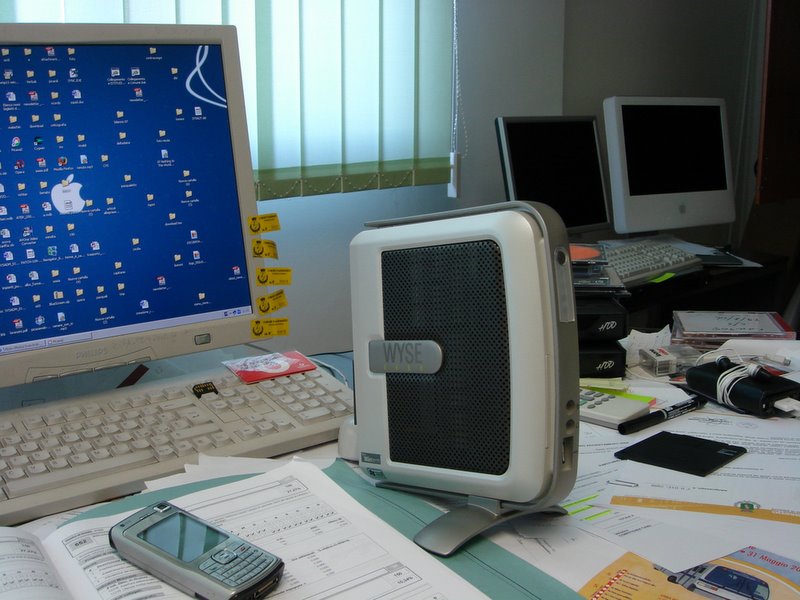

Wyse Technology Thin Client


A Thin Client by Wyse Technology

Another way to save cost for business is thin-client computing. Thin-client computing involves minimalist computer hardware called thin clients. Thin clients are tiny in size, cute in shape, non-obtrusive, and have little memory and low computing power. They typically come with a minimal set of software such as web browser, telnet, SSH, and Remote Desktop client. Thin-client computing may save cost for business both in hardware and software level and keeps your office clutter-free. You use thin clients to access business software running on the central server over the LAN or WAN. In that sense, thin-client computing is similar to cloud computing except that thin-client computing involves minimalist hardware.

Thin-client computing has several advantages: For one thing, you can buy only one copy of business software and install it in just one computer, the central server, therefore reducing software expense. Second, thin-client computing facilitates centralization of data in the server and prevents duplicate, often incorrect data. If you install business software on several computers and move your data around them, you can end up having duplicate data in several computers, wondering which one is the latest relevant copy. Lastly, thin clients consume less power and emit less heat, thereby reducing energy bill for your business. I find thin-client computing attractive but need further research.

As for the alternative to Windows Vista, I recommend using Linux. Recent breakthrough in technology and usability in the Linux operating system have helped Linux become a sensible alternative to Microsoft Windows. A good commercial-grade Linux distribution is CentOS. Nevertheless, Linux can be a daunting experience for first-time users. For Linux beginners, a friendly Linux expert in your neighborhood will be helpful.

If you are forced to stick with Windows Vista, there are still cost-saving alternatives to the rest of software. As for office suites, there are OpenOffice.org and IBM/Lotus Symphony.

If you don't like office suites, there are free stand-alone applications. Abiword is a fine word processor. Gnumeric is a nice spreadsheet program. For desktop publishing, there's excellent Scribus. For drawing and photo editing, you got fantastic GIMP. For vector graphics, Inkscape is a free excellent choice.

For virus protection, I recommend Avast! Antivirus Home Edition. It's free for non-commercial personal use, though. Alternatively, you can get completely free ClamWin which might do the job.

For accounting, you can use GnuCash or TurboCASH.

My Blogger Adventure

I got my own spot on Blogger. I chose Rounders 3 template as my blog layout. I tried to make both the blog post column and the sidebar wider, but to no avail. Adding gadgets and feeds to the sidebar and the bottom took some time.

I searched for free Blogger templates and found a nice website btemplates. I even downloaded cool templates like Raibow, Bright Side of Life and Notepad Chaos. But when I applied the new templates, they messed up my blog and removed feeds from the sidebar. Obviously, to apply fancy templates, it takes good HTML/CSS skills which I lack. After tweaking for a while, I gave up and decided to stick with the generic template.

Now, the next step is to figure out how to monetize my blog. Blogger provides built-in settings to insert AdSense to your blog layout. But I don't have good traffic to utilize AdSense yet. There's also Amazon Associates program (you receive a referral fee if someone buys a book, CD, etc. via a link from your blog) that's not as obtrusive as AdSense.

Anyway, trying to monetize my blog may deteriorate the quality of my blog. It's common dillema faced by serious bloggers: quality vs quantity. According to a Slate article, lame blogs are characterized by

top-10 lists, recycled ideas, half-baked notions, lots of viral videos, and a general increase in information pollution ... dubious crap.
Hey, that's sort of demeaning for hard-working bloggers.


Anyway, here's a definitive report on the world of blog: Technorati: State of the Blogosphere 2008

Tuesday, September 30, 2008

CDO: Wicked Invention That Got Bankers in Trouble


The Subprime Financial Crisis Explained Simply Part 1 @ Yahoo! Video

Have you heard of CDO? Hardly anybody knows CDO unless a seasoned investor.
But if you read articles on business lately, you may stumble upon this word. CDO stands for collateralized debt obligation. It's a very tricky invention that allows bankers to make money off of bad loans. A CDO package is created by packaging high risk loans — mortgages given to people with low income and bad credit — and good loans together into a high interest investment package so that banks can sell the CDO package to gullible investors or another bank. This way, banks can get rid of risky baggage off their books and make money at the same time.

CDO's are supposed to guarantee earnings even if some of the loans go bad. But in the past year, most of the mortgages that make up CDO's went default. Malfunctioning CDO's are the main reason why many big banks have crumbled.

Here's a nice presentation of CDO by portfolio.com.

What's a C.D.O.? Business Interactive Features - Diagrams - Illustrations

Sunday, September 28, 2008

My Take on the Financial Bubble: Energy Cold War

I've been hearing news about subprime mortgage crisis and skyrocketing gas price. I knew critical events were happening when I heard Aloha airline going broke and people losing their jobs and homes. But honestly, it wasn't until a few weeks ago that I realized how serious the situation was. In the last few days, major financial institutions like Lehman Bros, Merrill Lynch, Washington Mutual and AIG have hopelessly failed. Now, the government is rolling out a whopping $700 billion bailout plan to save the financial market.

Being a regular joe, it's not like I can fly to Washington and have a say about the $700B bailout plan. Maybe the bailout will save us from going further into economic crisis.

What's the cause of this financial bubble? Some say it's the subprime lending. Frankly, I don't see a problem with lending money to low-income people with credit problems. People should all get equal opportunities in buying new homes whether they have good credit or not.

I think the housing bubble began to surface when crude oil price started to rise. Rising gas price resulted in rise in food prices, too. Climbing costs of living was too much for people to handle, so they couldn't pay their mortgages any more. That's how this housing bubble started.


The more I think about it, the clearer things become. It was all about the oil, or more generally, the energy resources.

As the world population increases, the natural resources become more and more scarce. Among the most precious natural resources is the fossil fuel such as oil and natural gas. In fact, the world events are moving around the context of energy resources. The recent Russian-Georgian conflict, Iran standoff, Iraq war and Afghanistan war were all motivated by the need for control of energy resources.

Now, nations are beginning to weaponize their natural resources. Russia has long since seized oil and natural gas companies under government control. And the recent Russian conflict with Georgia was believed to be motivated by Russian interests in the underground natural gas pipeline through the conflict territory.

The soaring gas price across the globe may be the work of natural resource weaponization. OPEC kept tight control of oil supply and drove up the price of crude oil across the globe to the United States. The majority of OPEC members are Arab nations. Maybe the Arabs were so threatened by the establishment of Americanized liberal democratic nation in their midst that they covertly designed a counter attack of soaring oil price and delivered it to the US, thus dealing a fatal blow to the US economy.

The world is now entering a new era of cold war, and this war revolves around one goal. That goal is to capture the most of ever so scarce sources of energy.

Saturday, September 27, 2008

Who's to Blame for Economic Downfall?

When a natural disaster strikes, we have no one to blame but God or Mother Nature. Yet, when the economy goes bad, there surely is someone to blame because economy is totally a human affair. Now that the US economy is freefalling and possibly heading for the second Great Depression, many bright minds are asking themselves: How did the economy arrive at this mess? Who's responsible for this economic downfall?


An ongoing poll by Portpolio.com allows people to play a blame game in which they pick the culprit "who's most responsible for the current economic crisis." More than 20,000 people have participated in this poll. Some of the candidates are as follows:


Alan Greenspan

Alan Greenspan

Former Chairman of Federal Reserve, Alan Greenspan was once revered by everyone in Academia as economic genius, but now no one seems to hesitate pointing finger at him as the chief culprit of US economic doom. Overly supportive of easing lending standards and keeping low-interest rates too long, he's in part responsible for the current subprime debacle.

All the time, his low-rate, cheap-money mantra fooled low-income people with second-rate credit into believing that he was looking out for them, but all along, he was kissing up to greedy mortgage lenders, creating financial monsters doomed to self-destruction.

Now, we've seen continous collapses of financial institutions: American Home Mortgage, Countrywide Financial, Bear Stearns, IndyMac, Fannie Mae, Freddie Mac, Lehman Brothers, Merrill Lynch, AIG and Washington Mutual. It all started with overly deregulated policies of Alan Greenspan. Talk about free market. It led to market failure.


George Bush

President Bush

Mr. President must have got bad grades in Economics in college. Or, is it simply that he was ill-advised by his advisors? Obviously, his priorities were not on U.S. Economy, but rather on War against Terrorism. His mind was so occupied with wars in Iraq and Afghanistan and with threats from the so-called axis of evil — Iran and North Korea — that he failed to notice the early signs of failing domestic economy. He kept using the same stimulus gimmicks and rate cuts to keep the economy alive and the Republicans in power. Now that the economy is crashing, his 700 billion dollar rescue plan may be too late, too costly for already suffering people.


Moody's and S&P

These ratings agencies gave too rosy credit ratings for shaky financial companies. Their misleading ratings for failing investment bankers have left the market unprepared for the coming turmoil. When it all came, it was too late for many investors and bankers. People put too much faith in these ratings agencies. And now we suffer.


Hedge Funds

Those who invest in hedge funds are a select group of greedy wealthy investors who engage in short selling of risky investments for quick and big money. Their short selling activities have resulted in roller coaster ride of the stock market. Those reckless hedge fund managers wanted quick profits and made all the odd, risky investments that, when the market began to crumble, had dire effects on the financial market. The recent crackdown on short selling in Wall Street should give a good lesson to those greedy risk-takers.

Angelo Mozilo

Angelo Mozilo

Cofounder of Countrywide Financial and IndyMac, he let Countrywide hand out mortgages like play money. Countrywide, like many other mortgage lenders, doled out easy money to subprime home buyers without income or job verification. But by 2007 Countrywide was struggling with rising rates. Countrywide's collapse and subsequent bailout by Bank of America was a prelude to the current financial market meltdown.

Saudi Arabian King

OPEC

Some don't seem able to make connection between soaring oil price and the current financial crisis. My understanding is that high oil price has caused several airline bankruptcies, inflation and rising costs of living. The soaring gas price and inflation have put so much burden on people that they couldn't pay their mortgages any more. That's how the housing bubble started. People blame OPEC for keeping oil supply tight and driving oil price high. But I disagree. I believe the high gas price is the result of speculatory investing. Who are the real conspirators, Arab nations plotting against infidels or greedy Wall Street speculators? Anyway, it's time to invest in the development of alternative energy resources.

Fannie and Freddie

These government-subsidized, publically traded mortgage companies made too many bad loans on home mortgages with taxpayer's money. When the real estate values slid, their poor management has caused loss of consumer confidence in the housing market and caused their stock prices to hit the bottom. Government bailout of these companies would only cost taxpayers plenty money.

National Association of RealtorsCondos in St. Petersburg, FL

This group of crooks ripped millions of home buyers with fraudulent real estate appraisals and relentlessly put out misleading positive outlooks on the real estate market even as it began to plummet. If they had been honest with home buyers, people wouldn't have bought those townhouses in Naples, Florida or Phoenix and later go default on bad loans.

China

When we get trouble, we blame it on our trade partner. But if you think about it, which country in the world has the greatest demand for the globe's natural resources and caused oil price to skyrocket? Not only that, China continues to give US trade deficit and keeps piling in our dollars. All this weakened our economy and contributed to the current crisis. China must stop exporting poisoned food. It's time we find a new trade partner who knows what moral and ethics truly mean. How about India, Mexico or Brazil?


After all, I believe everyone is both a participant and a victim of this economic debacle that stemmed from greed. And we all have to share the pain for a long time.

Tuesday, September 23, 2008

Forbes: How To Build A Killer Small Business Web Site

Forbes published an introductory article on building a small business web site. It gives some good tips such as:
  • Provide detailed information on your products and service. Create a good catalog with an easy-to-use search function. Let people know what you are specialized in.
  • When choosing a domain name for your site, go with direct names that are easy to remember.
  • Design your site with easy navigation in mind.
  • Establish credibility with your business personnel's background, accomplishments and head shots.
  • Respectable client list and glowing testimonials can be smart marketing tools.
  • Use graphics and Flash sparingly and only go for the highest quality.

That's not so hard to figure out on our own. But this article also gives insight on Search Engine Optimization. As you know, people use Google or Yahoo! Search to find what they want everyday. So making your site show up at the top of the search results can be critical of your business success. Search Engine Optimization techniques given by this article include:
  • Select 50 to 100 keywords most relevant to your products, services and target audience and stuff your web pages with as many of them as reasonably possible. Go to Google AdWords to see which keywords are related to each other.
  • Also include Zip code, city and region with your keywords.
  • Placement on online local business directory can be helpful. Suggestion includes Yahoo! Local, Yelp.com, Craig's List and Insiderpages.
  • Attach meta tags that include your top 20 keywords in order of importance.

Occasionally test your site design with tools like Web Trax or Offermatica.com . These tools measure click throughs.

Blogger Tips

There are some free blog editors available on the Internet. I like Post2Blog that's a free program you can use to edit and post blogs.

You can post your blog by emailing Blogger. This way, you can use the superior HTML editing feature of your email service or application. You can set the email address of your blog by logging in Blogger and going to Settings > Email. Here's a howto on that. When you post your blog by email, put #end at the end of your email to avoid ad shown at the bottom of your post.

You can also add RSS feed of your blog to browser bookmarks, email client or your personalized portal such as MyYahoo!, iGoogle, MyMSN or MyAOL. RSS feeds give you updates of your favorite site right to your application or homepage. In your browser, click on the RSS icon at the top to subscribe to the feed.

If you want to draw traffic to your blog, why not add buttons for Yahoo! Buzz, Mixx, Digg or Reddit?

Saturday, September 13, 2008

Video clips: Economy and Election

Economist Shiller talks about the current problems affecting the US economy. He suggests some solutions such as improving risk management infrastructure and house equity insurance. He speaks in difficult economic lingo but I think it's worth watching because he's a renowned economist.


Here's another interesting Tech Ticker clip. Suddenly, the presidential candidates' wealth takes center stage. Does it really matter how rich the candidates are? You decide with your vote. They seem to be bashing McCain and his wife for their excessive wealth.


Now this funny video is by one of Sarah Palin impersonators. Republican VP candidate Sarah Palin is quite popular recently and giving Republican camp some boost. Hope you find it funny.


See more Gina Gershon videos at Funny or Die

Sunday, September 7, 2008

Blogging for money


As a business student, I tend to look at things from business perspective. So as a new blogger, I began wondering whether it was possible to make money by blogging. I warn you I am not an expert on this. Let's say I am just brainstorming about blogging business.

Blogging is a type of journalism, specifically freelance journalism. You don't write for news media company but you post your uncensored writings to your blog site on the Internet.

Traditional journalism businesses like newspapers, radio and TV have most of their revenue generated from advertisement. To demand higher price for advertisement, they need to have bigger readership, audience or viewership. In order to have larger audience, they need good contents to attract more people. So, logically good contents is critical in generating more revenue for journalism business through advertising.

Now we live in Internet era. Internet is changing our daily life and also the business world. Internet had serious impact on traditional journalism business, especially newspapers. Nearly every newspaper company across America has lost more than half its revenue recently. Guess where people get their news from instead of reading newspapers. Of course, on the Internet.

People read news from major online News sites like Bloomberg and Wall Street Journal online. But besides major News sites, people also get news and latest buzz from blogs. Since Blog is a new type of journalism on the Internet, it also make sense to apply revenue generating mechanism of traditional journalism to Blog. That is to make money from blogs through advertising. In case you didn't know, online advertising is the most profitable business on the Internet. The richest Internet company Google makes most of its money from online advertising. Google does it by placing a little banner or column of text ads across all over the Internet. This ad system by Google is called AdSense.

So if you want to make some money off your blog, you would probably want to place some ads on your blog, such as AdSense. Every time people click on the ad, you make a few cents - I don't know how much exactly. You can click on the ads on your blog, but that's illegal and called click fraud.

However, if you want to make good money through ads on your blog, you need to draw a considerable number of people to your site. To make that happen, you should have good contents for your blog just like traditional journalism. Sure, you don't have to write trustworthy news like those on the newspaper. It can be celebrity gossip, political rants or anything interesting.

Even if you have good contents, you won't make money if nobody knows about your blog. You have to make your blog known. One way to do it is through Search Engine Optimization. What SEO means essentially is to make your site appear among the top search results from Google or Yahoo! Another way to make your blog known is to have your blog article voted in social news sites such as Digg or Yahoo! Buzz. I won't go deep into SEO or Yahoo! Buzz since I am not an expert on this.

So to make it short, I think it's possible to make money from blogging if you keep publishing good contents on your blog to keep your readers interested. Also you should know how to make your blog popular and draw traffic to your blog.

Free and Commercial Office Suite Alternatives

Modern computing can hardly be done without office suites, that is, word processor, spreadsheet, presentation etc. The market for office suites today is dominated by Microsoft Office. The problem is its too expensive and so resource-hungry that it can't run on old computers. For Linux enthusiasts like me, the main disadvantages of Microsoft Office are its inability to run on Linux or any other open-source operating system.

So I began searching for alternative Office software I can use instead of the evil product from Microsoft. Here we go.


1. OpenOffice.org

Undeniably the best free office suite, OpenOffice.org is an open-source office suite that well integrates each office components such as Writer, Calc and Impress. It is freely available for download for Windows, Mac and Linux.


2. IBM Lotus Symphony

After unpopular Lotus SmartSuite, Lotus has shifted its focus on developing a new office suite based on OpenOffice.org technology. The interface looks a lot clean and attractive. You should give it a try.


3. Hancom Office

Best office suite for users of Asian languages, Hancom Office is developed by Korean software company, Haansoft. With good support for Chinese, Japanese and Korean languages, Hancom Office also processes English language well, of course. But its awkward English user interface may intimidate English speakers.


4. Thinkfree office

Another product from Haansoft, Thinkfree Office is made with Java. That means it can run on Windows, Mac and Linux without a problem. However, since it runs on top of Java, it may not run so effectively. There is also Web version of Thinkfree Office that you can access and use with your Web browser such as Mozilla Firefox. This means Thinkfree has a potential to become a big player in the coming Internet-oriented computing era.


5. Lotus Smartsuite

This is a very fine product that deserves attention. Now nobody seems to use it and it's being forgotten. It shouldn't be, but sadly it's true. You can still try it. It is sold very cheap on the Internet. Its major flaw is that it doesn't seem to support Unicode although it claims it does.


6. WordPerfect Suite

Still surviving office suite for niche users like lawyers and professionals, WordPerfect Suite also has good functionality. Its main strength is its wordprocessor WordPerfect.


7. Microsoft Office

You are forced to use it simply because everybody else uses Microsoft Office and hands you documents in its proprietary format. What a sad reality. Of course, you don't have to use it, let alone buy it. Use OpenOffice.org instead. Just tell your friends and colleagues to use OpenOffice.org or Lotus Symphony. Petition your school and government to use OpenOffice.org. Take action, please.


In summary, my clear choice is OpenOffice.org. I should master OpenOffice.org and make a transition from other office programs to OpenOffice.org.

Saturday, August 30, 2008

Improving the Performance of Vista computers

Understanding Performance Issues
As a computer is used to access information on the internet, and additional programs are added, the computer's performance may begin to degrade.
Use one or more of the methods outlined in the sections below to resolve issues and improve system performance, and perform routine maintenance tasks according to the schedule in the tables below to ensure that your computer continues to work optimally.
Recommended schedule of maintenance tasks
Click any link for more information on tasks in the maintenance schedule.


Weekly Monthly Occasionally
Run Windows Update X


Scan for and remove viruses and spyware X


Empty the Recycle Bin X


Delete temporary Internet files X


Back up user files

X

Create a restore point

X

Defragment the hard drive

X

Run Scan Disk

X

Clean the computer


X
Close programs that are not being used


X
Prevent programs from loading at startup


X


Run Windows Update
Weekly: Check for updates with Windows Update.
The Windows Update feature can be used to update your drivers and operating system on a weekly basis. Drivers are software that allows the operating system to communicate with hardware on your computer, such as the video and sound cards. An updated driver will allow your devices to work optimally with all the programs that you use.

You may also check for updates manually at any time. Click Start , type update , and select Windows Update when it appears in the program list. Windows Update may be configured to check for updates once a week.
Scan for and remove viruses and spyware

Weekly: Update your virus definitions and scan for viruses and spyware.
You can scan your computer for harmful and unwanted material using programs such as avast! Antivirus Home and Windows Defender. I recommend setting your antivirus program to check for updates automatically once a week, and scheduling it for a time at which the computer will not be doing other work.

Frequently, clicking banner ads and other popup windows online can install adware, which will then run in the background on your machine, taking up memory and diverting system resources from the programs that you actually wish to run. This may include sometimes annoying pop-up windows. Spyware is any application that collects information from the computer and sends that information to another computer over the Internet.
Empty the Recycle Bin
Weekly: Empty files from your recycle bin.
It's important to delete files that are no longer in use, particularly temporary internet files, because they can fill up a hard drive quickly, and slow down performance.
Deleting a file is a two-step operation. Simply right-clicking on a file and selecting delete only marks the file for deletion, and stores the file temporarily in the Recycle Bin. Then the Recycle Bin must be emptied to delete the files within it permanently. Files that are mistakenly deleted can be retrieved from the Recycle Bin at any time prior to the emptying step.
If you are concerned about which files will be permanently deleted, open the Recycle Bin and view the file names by following the steps below:
  1. From the Windows desktop, right-click the Recycle Bin , and select Open to view the contents of the Recycle Bin.
  2. Select any file that is mistakenly marked for deletion, then right-click it and select Restore from the drop-down menu.
  3. The file will be returned to its original location on the hard drive.
Files that remain stored in the Recycle Bin take up disk space and can slow your computer's operation. To empty the Recycle Bin, follow the steps below at least once a week.
  1. From the Windows desktop, right-click the Recycle Bin and select Empty Recycle Bin .
  2. Select Yes to confirm the deletion of multiple files.
    Windows will remove the contents of the Recycle Bin from the hard disk.
Now that you've permanently deleted these unneeded files, and have reduced the amount of memory used on your computer, continue the maintenance process by going to the Scan the hard drive for errors section below.
Delete temporary Internet files
Weekly: Delete unused and temporary files.
Windows uses several directories, such as the C:\WINDOWS\TEMP directory, to store files (*.tmp, *.spc) intended only for temporary use. Over time, the number of files can build up and slow the operation of programs, such as print spooling.
Windows Vista provides the Disk Cleanup utility to help you find and remove temporary files on your computer, which can include internet files, cache files, and other temporary files created automatically by some programs in between full saves. It is important to delete temporary files, because they can fill up a hard drive quickly, and slow down performance. To use Disk Cleanup, follow the steps below.
  1. Click Start , and type Disk in the search field, and select Disk Cleanup from the list. If prompted, permit the action to continue.
  2. If prompted, select My files only , then select your hard drive, (C:) , and click OK .
  3. After the program evaluates your hard drive space, Disk Cleanup will show you a list of how much space can be saved by deleting various categories of files. Place a check next to the types of files you wish to be deleted. It is always safe to delete temporary files, internet files, and recycle bin files. Accept the default settings by clicking OK , confirm the decision by selecting Delete Files , and allow Disk Cleanup to finish its operations.
You've saved space by marking unneeded and unused files for deletion. In order to delete these files permanently, continue to the Permanently delete unneeded files using the Recycle Bin section below.
Back up user files
Monthly: Save important files to disc.
Back up your files to disc or other external storage media to protect them from being lost or changed.
  • Back up your files manually, by copying them to an external storage service, such as a flash media stick, an optical disc, or an external hard drive, or,
  • Use the Backup and Restore Center to allow Windows Vista to select files from categories that you choose, and back them up on a daily, weekly, or monthly schedule on a separate partition of your hard drive.
Create a restore point
Monthly: Create a restore point before cleaning up the hard drive.
Before you delete files or perform a Disk Cleanup, you may wish to create a restore point. A restore point is a copy of your computer's system files at a specific point in time. Restore points are created by System Restore at automatic intervals and also when Windows Vista detects that you've made changes to your system.
Run Scan Disk
Monthly: Scan the hard drive for errors
It's a good idea to check on the physical condition of the hard drive itself once a month. Error-checking will allow you to determine if any bad sectors exist, and repair them.
  1. Close all programs including background programs such as virus scanners and screen savers.
  2. Click Start > Computer . The Computer window opens.
  3. Right-click the hard drive's icon (C:) .
  4. Click Properties , and then click the Tools tab.
  5. Under Error-checking , click the Check Now button.
  6. Place checkmarks in the check boxes for the Automatically fix file system errors and Scan for and attempt recovery of bad sectors options.
  7. Click Start , and click Schedule disk check allow a full disk scan when the computer is restarted.
  8. Restart the computer to start the disk check. The disk scan can take a very long time to complete.
  9. The results of the error-checking is displayed. Click Close to exit program when finished.
Now that you've made all these changes, it's a good idea to consolidate and reorganize the files that are still on your hard drive. To improve drive efficiency by consolidating files, continue to the Defragment the hard drive section below.
Defragment the hard drive
Monthly: Defragment your hard drive.
During normal operation, a computer generates temporary save files, but it does not automatically clean up or remove these files. As a computer is used, the small temporary files and larger data files on the hard drive become fragmented. That means that the files are divided into small pieces and stored in different locations on the drive. When a file is needed, it takes time for the hard drive to find and reassemble all the pieces.
To improve the performance of you're the hard drive, you should periodically use the Windows Disk defragment program to consolidate and reorganize the fragmented files and folders on the hard drive. I recommend doing so at least once a month.


NOTE: Automatic defragmentation requires that the computer be turned on during the scheduled time. If your computer is not turned on when you have scheduled the process, the software will attempt to defragment your computer the next time you turn on the machine.
  1. Click Start , and type Disk in the search field, and select Disk Defragmenter from the list. If prompted, permit the action to continue.
  2. Select Defragment now .
    If you wish to change the schedule for automatic defragmentation, you may do so now by selecting Modify schedule .
Your computer will now go through a defragmentation process, which may take several minutes, or up to an hour, depending on the severity of your file structure's fragmentation.
Clean the computer
Occasionally: Clean the hardware.
Extend the life of your computer by removing potentially damaging dust, dirt, pet hair, and other buildup.
Close programs that are not being used
Occasionally: Close programs that you are not using currently
It is a good idea to save any user data and close a program when a task is finished. Minimizing the window for a program does not stop that program from using the computer's processor and memory. Close unnecessary programs to help the computer perform more efficiently.
Activities, like being connected to the Internet, listening to music, and running virus scans all use a lot of system resources. Schedule the use of virus scans and other system tools for a time when the computer is not being used. Work offline when convenient.
Prevent programs from loading at startup
Occasionally: Prevent programs from loading at startup if performance degrades
At startup, many programs launch background processes that take up space in memory waiting for to be used. For example, scanners, photo viewers, Bluetooth devices, and camera software can all load on startup, and remain resident in memory, even when not actively in use. Most of these processes are not needed by every program or game. If your computer is running slowly and overall performance seems to have degraded since you first received your computer, removing these speciality programs from a normal startup may improve overall performance.
WARNING: Disabling system-critical items could cause the computer to stop operating. Research all unknown task items before disabling them.
Use the System Configuration Utility to prevent items from starting when Windows launches by following the steps below.
  1. Click Start and type System Configuration in the search field. Select System Configuration from the menu when it becomes available.
  2. Click the General tab, and then select Selective Startup .
  3. On the Startup tab, clear the check boxes from any tasks that do not contribute to system performance and are unwanted. Do not clear a task check box if you do not understand the task function. Research unknown task functions on the Internet.


    NOTE: If Windows or other software stops working after a task check box has been cleared, restart the computer, go to the Startup tab on the System Configuration Utility and replace the checkmark. Restarting the computer will mean losing your place in this document. You may wish to print these instructions before restarting.
  4. After removing the checkmark from the unwanted files, click OK to accept the changes. Restart the computer.
Research all unknown task items before disabling them. To research an unknown task in the startup configuration, press Ctrl+Alt+Del . Select Task Manager , and then select the Process tab. For any process listed under Image Name that you do not recognize, use an internet search engine such as Yahoo! to look up the image name, and see what programs it relates to, and what other users say about it.

About This Blog

KBlog logo This blog seeks to provide a collection of interesting pictures found on the Web. Thanks for visiting the blog and posting your comments.

© Contents by KBlog

© Blogger template by Emporium Digital 2008

Followers

Total Pageviews

Powered By Blogger